



Music and memory collide in the strangest places. Say, the cereal aisle on a Tuesday afternoon.
A song drifts out of the store speakers. You haven’t heard it in twenty years. Within four bars, you’re seventeen again, slouched in the passenger seat of a specific car on a specific night, window down, someone drumming the steering wheel.
You can smell the cut grass. You can feel the seat sticking to the backs of your legs. The cart in your hands disappears.
That’s more time travel than mood, and the ticket costs nothing. So why does a few seconds of music beat a photograph, a diary entry, or a name you’ve known for years? The answer runs deeper than sentiment.
The Science: How Music and Memory Wire Together
Researchers have a name for the cereal-aisle moment: music-evoked autobiographical memories, or MEAMs.
Neuroscientist Petr Janata has chased them for years. In a 2007 study with Stefan Tomic and Sonja Rakowski, an average of 30 percent of the songs listeners heard evoked an autobiographical memory.
Two years later, Janata put listeners in an fMRI scanner and played them 30 excerpts. On average, 42 percent landed as somewhat or strongly autobiographical. Nobody asked the listeners to dig for memories. The memories surfaced on their own.
Janata also found a region in the medial prefrontal cortex, tucked behind the forehead, that tracked how personal each song felt. He proposed it acts as the link between a song’s musical structure and the episodes of a life.
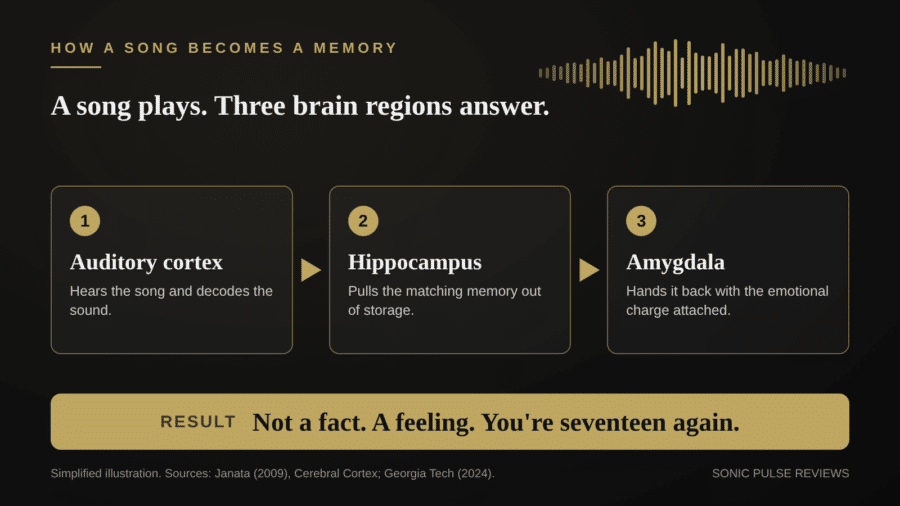
Think of three characters. The auditory cortex hears the song. The hippocampus pulls the memory out of storage. The amygdala hands it back with the emotional charge still attached. That’s why the memory doesn’t arrive as a fact. It arrives as a feeling.
And the time machine does more than replay the past. It can repaint it. In a 2024 Georgia Tech study, participants memorized neutral stories, then recalled them while positive music played.
Later, in silence, they remembered those stories as more positive. Brain scans showed the amygdala and hippocampus working in tandem, with a line open to the visual areas that help us picture the scene.
The researchers note that more work is needed, and a lab story about a stranger differs from your first heartbreak. Still, the direction is clear. Music opens the door to the past, then rearranges the furniture.
Amy Belfi and colleagues pitted 30 songs against 30 famous faces. Music memories came out more vivid, with more internal and perceptual detail. Faces produced more external detail, the facts rather than the feeling. In a head-to-head with a human face, a song wins.
Why the Songs of Your Teens Hit Hardest
Ask someone for the song that means the most to them and watch what year they land on. It’s almost never last year.
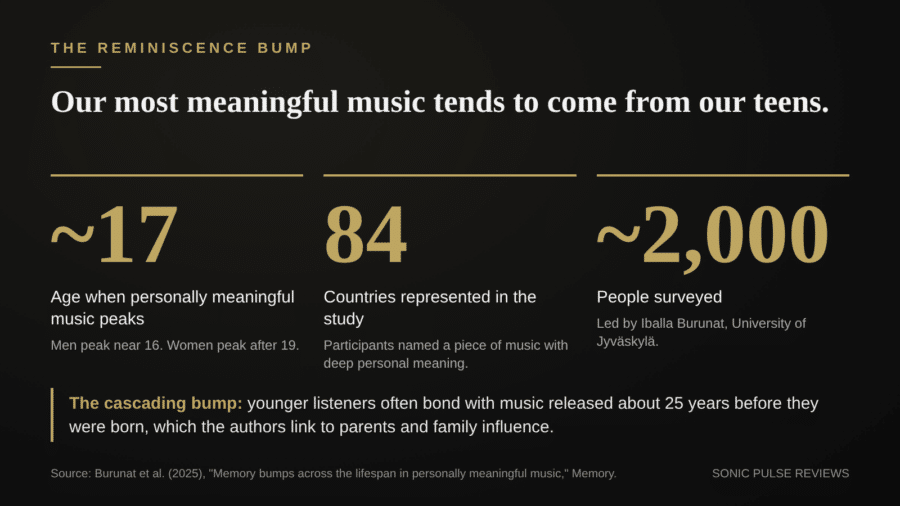
A University of Jyväskylä study led by Iballa Burunat asked nearly 2,000 people across 84 countries to name a piece of music with deep personal meaning. The peak hit around age 17.
Why adolescence? One answer comes from University of Leeds researchers, who proposed in 2008 that the “reminiscence bump” coincides with “the emergence of a stable and enduring self,” as Slate reported.
Slate’s own framing of that window, roughly ages 12 to 22, says it best: it’s “the time when you become you.” The songs on in the background while you built yourself get filed as part of the build.
The study adds two wrinkles worth knowing. For women, the most meaningful songs often shift around the mid-forties toward recent music tied to current relationships and personal growth. For men, adolescent music tends to stay the anchor.
Then comes the part that will make any record collector grin.
Younger listeners often bond with music released about 25 years before they were born. The researchers call it the “cascading reminiscence bump,” and they point to cross-generational influence: the records on a parent’s shelf, the song playing in the family car.
They offer that as an interpretation, not a proven cause. Anyone who grew up flipping through a parent’s vinyl knows how plausible it sounds.
Why Nostalgia Is a Feature, Not a Bug
Here’s the twist. For most of history, we treated this feeling as a sickness.
The word “nostalgia” dates to a 1688 medical dissertation by Johannes Hofer, and the disease label stuck into the 19th century. Psychologists Constantine Sedikides and Tim Wildschut reversed that verdict. In “Finding Meaning in Nostalgia,” they argue that nostalgia is not a medical disease, a psychiatric disorder, or a psychological illness. It’s a resource we reach for when life feels thin.
Their experiments back that up. People primed with nostalgia got less defensive after reading essays claiming life is meaningless. Nostalgia also buffered against thoughts of death, including death anxiety. Most of those studies used U.S. undergraduates, and the authors don’t pitch nostalgia as a cure-all.
Choosing Your Funeral Song
“I don’t want them to be sad.”
Ask people which one song they want played at their funeral, and the answers say plenty about how they want to be remembered. Talker Research surveyed 2,000 Americans as Newsweek reported.
“Amazing Grace” topped the list, followed by Frank Sinatra’s “My Way,” Led Zeppelin’s “Stairway to Heaven,” and Michael Jackson’s “You Are Not Alone.”
Others picked a smile over a sob. “Don’t Worry, Be Happy.” “Girls Just Wanna Have Fun.” One respondent chose Linda Clifford’s “If My Friends Could See Me Now” and explained: “I don’t want them to be sad.”
That’s the whole assignment in one line. It’s the last request of a life, and the goal is to make the room feel better.
The academic side backs the instinct. Researcher Janieke Bruin-Mollenhorst observed 44 funerals in Dutch crematoria and described what she calls the “musical eulogy.” Mourners set aside their own tastes and listen to the favorite song of the person who died. She found the lyrics matter less than the social and emotional work the music does: it recalls part of who that person was.
What I couldn’t find is research on the person making the choice while still alive. Surveys and funeral observations come closest. That gap fascinates me, so here’s my reflection, and I want to be clear it’s my musing, not a finding.
Normally, a song hijacks a memory by accident. Something comes on, and you’re back in that car.
A funeral song flips the mechanism.
You plant it on purpose, knowing it will someday trigger memories of you, in listeners you’ll never see again. It’s the one musical choice we make with full awareness of its memory-making power. And if the Jyväskylä authors are right that songs travel across generations, the track you pick may echo in people who never met you.
Why Music Memories Matter More Than Ever
Now zoom back out to the scroll.
Our feeds serve 15-second clips and algorithmic playlists built to guess what we might like. Fine. Guessing has its place. But a guess about your taste can’t know that one particular chorus is the summer you stopped being a kid. The algorithm predicts your next click. Your anthem remembers who you were.
That distinction matters because so much of our digital life evaporates. Posts vanish into the feed. Playlists refresh. Nothing sticks long enough to become a landmark. A song you chose, loved, and lived inside for months does the opposite. It gives you a fixed point, a place to stand when everything else keeps moving.
If Sedikides and Wildschut are right, those anchors do real psychological work. They help us feel our lives have meaning, and they cushion us when the big questions press in. Music didn’t need an update to do that. It only needed us to listen.
I wrote about why “I’m Not Lisa” means so much to me. Here’s my challenge: pick your songs on purpose. Play them loud. Tell someone why they matter. And if you haven’t picked your funeral song yet, start the list now. You’ll learn more about yourself in the process than any algorithm ever will.


Music and Memory: Why Songs Become Time Machines