



Music brings people together. It also draws lines.
I grew up on both sides of those lines.
Growing Up Outside the Lines of Music Genres
When recalling my earliest memories, there’s only a few that don’t involve music. It’s embedded that deeply into my soul. Even fewer of them are negative.
One is playing the trombone in elementary school. I can’t emphasize enough how much 10-year-old me hated lugging that thing to the bus stop. And yes, it was uphill.
The other is how music separated us back then. I came of age during the 70s, and popular music didn’t cross boundaries the way it does now. You stayed in your lane or risked being ostracized by your friends.
Unfortunately, those lanes were often defined by ethnicity or sexual orientation.
Motown, and the Exception That Proved the Rule
Having three older siblings who all had different music tastes, as well as my mom’s records, I was exposed to a lot of different artists as a young child. Most of it would have been considered “white” music.
Which didn’t make much sense, considering I literally grew up in Motown.
They were the exception, not the rule.
Motown was intentionally built to cross over. Berry Gordy built Motown into a highly polished machine meant to appeal to the masses. That era had passed by my teenage years, so it wasn’t a real part of my experience.
What I experienced instead were lines that felt a lot less flexible. I didn’t realize how real those lines were until I met Roger.
The Friend Who Opened My Ears
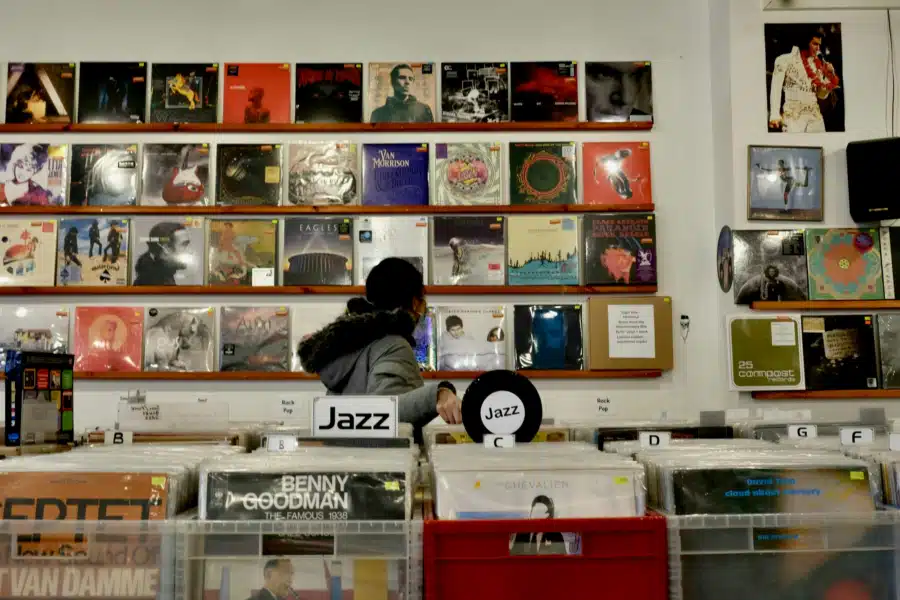
In 9th grade, I made a new friend. He would go on to become a brother, and best man at my wedding. It didn’t matter to me, but he just happened to be Puerto Rican. And he hated rock music with a passion.
So disco was on the radio when I was with Roger. And you know what? I really liked it!
One day Roger and I were walking together at an event, and we passed by a security guard who had a jazz station on the radio. Over 40 years later, I still remember exactly what he said:
“He’s listening to jazz. You wouldn’t know anything about that.”
It wasn’t mean. It wasn’t even serious.
But it landed.
Challenge Accepted
Ouch. It was just a friend ribbing a friend, but the words stung. I mumbled something back to him, but in my mind, I knew he was right.
So, I set out to correct that.
By the end of summer, I was sharing my favorite jazz records with Roger. We got so close his family became like family to me: siblings, cousins, aunts and uncles, all part of my life, along with music tied to Black, Latino, and LGBTQ+ communities.
Living in Two Worlds
I still had my white friends. So, I found myself subconsciously drifting between two different worlds.
Not because of bigotry. My Latino friends didn’t hate white people; they took me in. They hated “white people music.” My white friends didn’t hate Latinos — they hated the music they listened to.
I didn’t think about it at the time. It’s just how things worked. I was a teenager simply trying to have fun.
Until one day those two, very distinct music worlds collided.
The Stanley Clarke Incident
Roger and I shared a favorite song: “Rock ’n Roll Jelly” by jazz fusion bassist Stanley Clarke. On the day of a huge party at Roger’s house we hit a record store, and I bought Stanley’s album, I Wanna Play for You. The first track is a live version of the song.
We were excited. As soon as we got to the party, we headed straight for the turntable.
Dance music was playing. When the current song ended, Roger told me to go ahead and put my new record on.
To both of our horror, the sound coming out of those speakers was very hard rock. Apparently, the live version is a little different than the studio version.
A literal uproar followed. People were shouting. I tried to explain, but it came out as a weak: “But… it’s supposed to be jazz!”
I had committed the cardinal sin. I brought rock into their domain.
One of Roger’s neighbors (who also happened to be white) pulled me aside and explained, gently but firmly, you can’t play “that kind of music” here.
More mumbling. I called it a night.
When Music Genres and Identity Collided
It was no longer subconscious. I now made a conscious effort to keep those two worlds apart.
Genres were identity markers. I had crossed an invisible, but very real line.
The Boiling Point — Disco Demolition Night
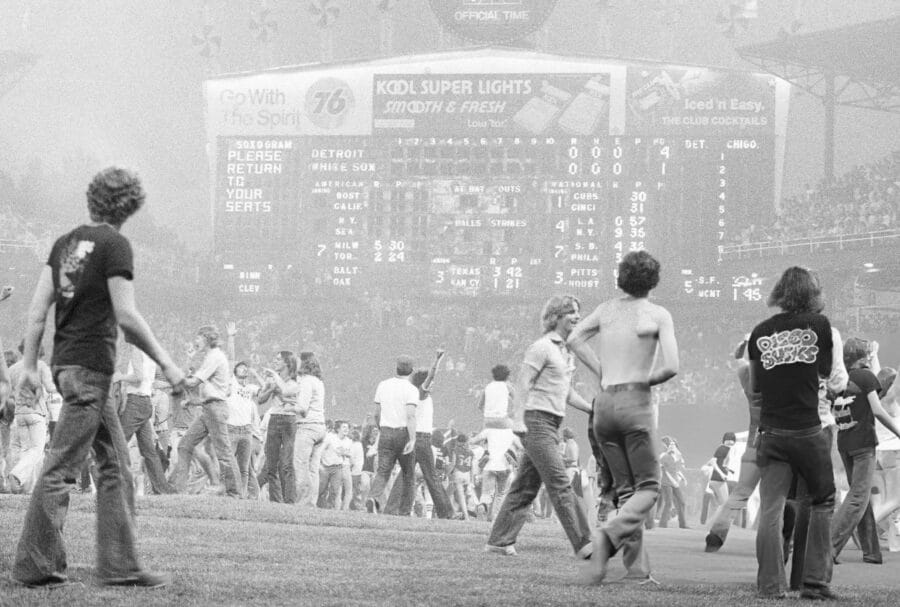
On July 12, 1979, “rock versus disco” came to a head during a promotional stunt at Comiskey Park in Chicago.
What I had experienced in my corner of the world was heating up nationally.
About 50,000 people showed up for 98¢ tickets if they brought a disco record. Between games, a crate of disco records was blown up. It also detonated the crowd.
Thousands stormed the field. Fires were lit. Equipment was destroyed. Riot police were called in. The second game was forfeited.
At the time, I only knew that something had happened. Looking back, the anger is impossible to ignore.
Why so much rage over music?
Disco was tied to Black, Latino, and LGBTQ+ communities. That places culture and identity directly into the mix.
Surely The 80s Will Be Different
After the disco riot brought those tensions into the open, I thought maybe things would change.
They didn’t.
I joined the Marine Corps in the early 80s. We were all “green,” and overt racism wasn’t prevalent. But off duty, we were still divided by music.
Once again, I found myself with two sets of friends.
I even relived the jazz moment in reverse. Listening to a fusion mixtape on my Walkman, a black platoon mate asked me what I was listening to. When I told him jazz, he didn’t believe me.
I handed him my Walkman so he could hear for himself. After an incredulous “You’re listening to this?” I was accepted into the club
And I was back to having two playlists, depending on who I was with.
What changed?
I didn’t see it coming. One day those lines just… started to blur.
I remember being surprised. The same music that once divided us was suddenly everywhere. Looking back, MTV’s impact can’t be overstated.
Early MTV played white rock. Then Michael Jackson broke through with Thriller. In 1986 Run-DMC and Aerosmith teamed up for “Walk This Way.”
That moment mattered. Cross-genre collaborations are routine in 2026, but 40 years earlier this was taking a sledgehammer to that barrier (they literally did that in the video).
For the first time, rock and hip-hop didn’t just coexist. They collided, visually and sonically.
I remember watching that video grinning ear to ear. It felt like something had finally changed.
When the Lines Finally Blurred
Hip-hop spread from urban centers to the suburbs. It became the sound of a generation, not a race.
White audiences engaged with Black music on its own terms, not a polished version like Motown. This wasn’t just music. It was part of a broader cultural shift, and the change was undeniable.
That didn’t erase everything overnight. It didn’t mean full integration.
But it changed something fundamental.
For the first time in my life, I didn’t need two playlists.


Music and Memory: Why Songs Become Time Machines