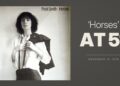
On November 10, 1975, Patti Smith released her debut album Horses on Arista Records.
Punk did not have a name in the mainstream yet. The Ramones were months from their first record, the Sex Pistols had barely formed, and CBGB was still a bar with good nights and bad plumbing.
Into that quiet before the storm, Smith walked in with the opening line of the decade: “Jesus died for somebody’s sins but not mine.”
Fifty-one years later, that line still carries voltage. And the album behind it still reads like a blueprint that half of rock forgot it was borrowing from.
How John Cale Shaped the Sound of Patti Smith's ‘Horses’
Smith arrived with poems, stage presence, and a band led by guitarist Lenny Kaye, whose Nuggets compilation liner notes had already defined garage rock for a generation. What she had never done was make an album. Clive Davis signed her to Arista anyway, betting that spoken-word intensity and rock energy could live on the same record.
Enter John Cale, formerly of the Velvet Underground, hired to produce.
The pairing sounded unlikely: a Welsh avant-gardist who thrived on drones and dissonance, handing shape to a poet who wanted a jukebox pulse.
That tension is the secret of Horses. Cale let the band breathe but kept the edges sharp. “Gloria” opens the record as a cover of Van Morrison’s garage-rock standard, rebuilt from the studs up, stretched across nearly six minutes, the familiar chord progression underneath a sermon Smith delivers like someone settling an old score.
The arrangement choices reward close listening. On “Redondo Beach,” reggae-inflected rhythm sits under lyrics about drowning and despair, sung almost sweetly.
The dissonance is the point. On “Land,” the album’s nine-minute centerpiece, the band builds and collapses around Smith’s stream-of-consciousness narrative, and the track ends up sounding like the record most of the 1980s American underground spent years trying to finish.
The ‘Horses’ Cover: Mapplethorpe's Photo That Sold the Album First
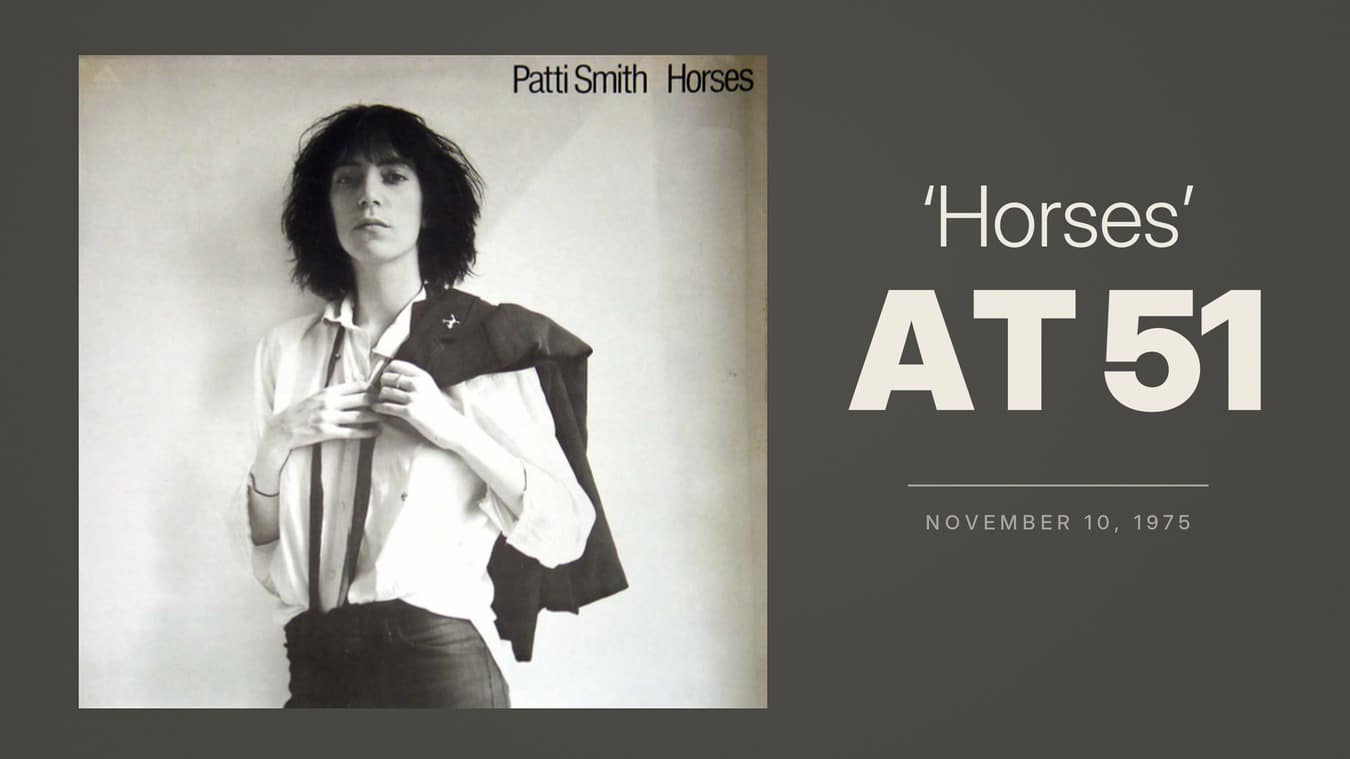
Robert Mapplethorpe shot the album cover, and it may be the most quoted photograph in rock packaging.
Smith in a white shirt, black jacket slung over her shoulder, jaw angled, eyes staring down the camera’s authority.
The pose borrows Frank Sinatra’s posture from an earlier era, but the intent is modern: this is what an artist looks like before anyone decides what she must be.
The cover did half the marketing before the record reached a shelf. It told record-store browsers exactly what kind of defiance waited on the vinyl: no logos, no glamour shot required.
The Legacy of Patti Smith's ‘Horses’: Who Listened and What They Built
Influence claims get thrown around carelessly in music writing, so here they are attached to actual outcomes. Michael Stipe bought the album as a teenager and has said it rewired how he thought about singing. PJ Harvey, U2, and Courtney Love all name-checked the record along the way.
The chart story is modest, and that is part of the lesson. Horses peaked at No. 47 on the Billboard 200 and didn’t crack the UK albums chart until its 50th-anniversary reissue, but it never needed to dominate radio to matter.
It operated as a transmission, something passed hand to hand among people assembling their own bands. Few records have justified the phrase “more influential than popular” more completely.
Why ‘Horses’ Still Holds Up 51 Years Later
Plenty of foundational albums survive as historical documents, valuable but frozen, played for archaeology rather than pleasure.
Horses avoids that fate because the performances stay alive on every listen. Smith does not recite her lyrics; she pushes them forward like she is still deciding where they land.
Kaye’s guitar keeps the poetry anchored in rhythm rather than letting it drift toward recitation. Cale’s production gives the record spine without sanding its urgency.
Some listeners find “Birdland” overlong (they’re wrong: it’s the emotional center of the record).
But the central claim survives every argument.
Punk needed a birth certificate, and the debate over where to file it will continue forever: Detroit, New York, London.
The filing location matters less than the fact that one debut album captured, in advance and in full, what punk would sound like when it finally had a name.
Drop the needle tonight. Side one is still a dare.